Baxter Bakery Equipment: The Leading Choice for Los Angeles Bakeries
Welcome to Origen Bakery Equipment, your trusted source for high-quality bakery machinery, located in El Monte, CA. We specialize in offering the best brands of commercial bakery equipment to help bakeries across Los Angeles improve efficiency, consistency, and product quality. One of the standout brands we proudly offer is Baxter Bakery Equipment Los Angeles—a name synonymous with innovation, reliability, and durability in the bakery industry.
Whether you're a small, artisanal bakery or a large-scale production facility, Baxter Bakery Equipment Los Angeles is designed to meet the unique needs of your business. From ovens to dough mixers, proofers to dividers, Baxter equipment provides the tools you need to succeed in a competitive market. If you're in Los Angeles and looking for top-tier bakery equipment, Origen Bakery Equipment is here to help you find the perfect Baxter Bakery Equipment Los Angeles to suit your needs.
What is Baxter Bakery Equipment?
Baxter Bakery Equipment is a leading manufacturer of commercial bakery machinery known for its exceptional performance, energy efficiency, and long-lasting durability. Trusted by bakeries all over the world, Baxter Bakery Equipment Los Angeles provides everything you need to take your bakery to the next level. From ovens that bake evenly and efficiently to mixers that guarantee the perfect dough every time, Baxter ensures that your bakery runs smoothly and produces high-quality products with minimal effort.
As a bakery equipment supplier, Origen Bakery Equipment is proud to offer a comprehensive selection of Baxter Bakery Equipment Los Angeles. Our mission is to help local bakeries in Los Angeles improve their production process, reduce operational costs, and increase overall profitability with the best equipment on the market.
Why Choose Baxter Bakery Equipment Los Angeles?
Investing in Baxter Bakery Equipment Los Angeles offers many advantages for bakeries of all sizes. Here's why Baxter is the best choice for your bakery:
- High-Quality, Durable Machines: Baxter Bakery Equipment Los Angeles is known for its sturdy, reliable machinery. Designed to withstand the heavy demands of daily bakery operations, these machines are built to last for many years with minimal maintenance.
- Cutting-Edge Technology: Baxter Bakery Equipment Los Angeles incorporates the latest in bakery technology, offering machines that are not only easy to use but also highly efficient. With automated features, precise control systems, and digital displays, Baxter equipment helps bakeries optimize their production.
- Increased Efficiency: From mixing and dividing dough to baking and cooling, Baxter Bakery Equipment Los Angeles is designed to increase productivity by reducing labor-intensive tasks and speeding up the baking process. This makes it easier for bakeries to handle large orders and high production volumes.
- Consistent Results: With Baxter Bakery Equipment Los Angeles, bakeries can rely on consistent results for every batch. The precision engineering of Baxter machines ensures uniformity in product size, shape, and quality—critical for maintaining customer satisfaction.
The Benefits of Baxter Bakery Equipment Los Angeles
When you choose Baxter Bakery Equipment Los Angeles, you gain several key benefits that help streamline your bakery operations:
- Reduced Labor Costs: Automation is a key feature of Baxter Bakery Equipment Los Angeles, reducing the need for manual labor in areas such as mixing, dividing, and proofing. This leads to significant savings on labor costs while improving productivity.
- Energy Efficiency: Many of Baxter Bakery Equipment Los Angeles’s machines are built with energy-efficient features that help lower your utility bills while maintaining high performance.
- Enhanced Product Quality: With Baxter Bakery Equipment Los Angeles, you get precision in every step of the baking process, ensuring high-quality products that will delight your customers every time.
- Flexibility for Any Size Bakery: Whether you run a small neighborhood bakery or a large commercial bakery, Baxter Bakery Equipment Los Angeles offers a range of machines designed to suit your needs, including machines built for scalability as your bakery grows.
Popular Baxter Bakery Equipment for Los Angeles Bakeries
At Origen Bakery Equipment, we carry a wide selection of Baxter Bakery Equipment Los Angeles, including some of the most popular and essential machines used in bakeries:
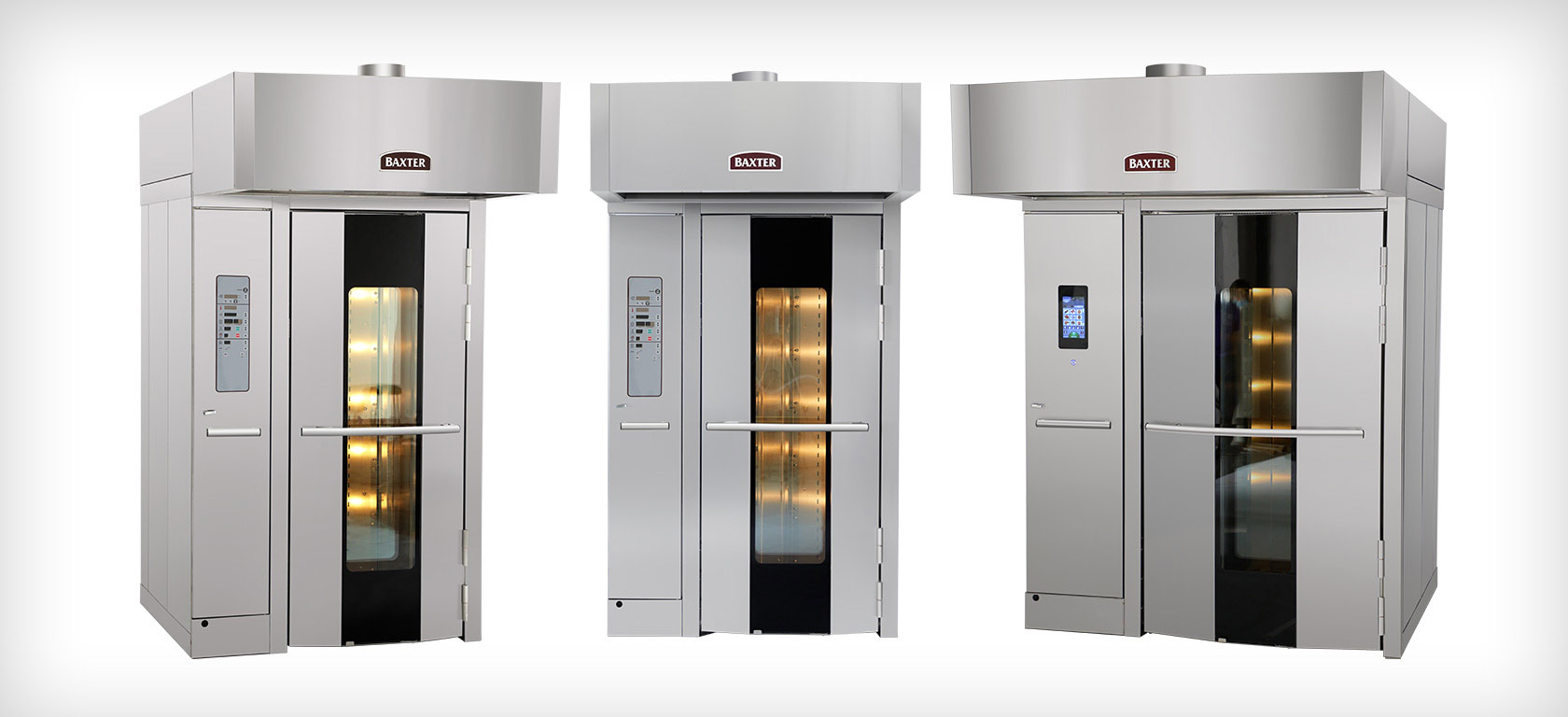
- Baxter Ovens: Baxter’s line of commercial ovens, including deck ovens, rotary ovens, and convection ovens, provide even heat distribution and consistent results every time. With Baxter Bakery Equipment Los Angeles, your bakery can produce everything from artisanal breads to pastries, all with the same high-quality baking performance.
- Baxter Dough Mixers: Baxter’s mixers are designed to handle large volumes of dough while ensuring thorough, consistent mixing. Whether you’re making bread, pizza dough, or cakes, these mixers are an essential part of your bakery operation.
- Baxter Dough Dividers and Rounders: For bakeries that need to divide dough into uniform portions, Baxter’s dough dividers and rounders deliver accuracy and efficiency. These machines reduce manual labor, allowing for higher production with less effort.
- Baxter Proofers: Baxter’s proofing systems create the optimal environment for dough to rise, ensuring that your baked goods have the perfect texture and flavor. With Baxter Bakery Equipment Los Angeles, your dough will rise to perfection every time.
- Baxter Bakery Refrigeration: Refrigeration is essential for maintaining the freshness of ingredients and finished products. Baxter’s refrigeration solutions keep your raw materials and products at the ideal temperature, preserving quality and extending shelf life.
Why Buy Baxter Bakery Equipment from Origen Bakery Equipment?
At Origen Bakery Equipment, we are committed to providing the highest quality service and support for your bakery equipment needs. Here's why Los Angeles bakeries choose us for Baxter Bakery Equipment Los Angeles:
- Expert Advice and Consultation: Our team of experts understands the unique needs of bakeries, and we work with you to identify the best Baxter Bakery Equipment Los Angeles to suit your specific production requirements.
- Competitive Pricing: We offer Baxter Bakery Equipment Los Angeles at competitive prices, ensuring you get top-quality equipment at a price that fits your budget.
- Fast Delivery: Located in El Monte, CA, we can quickly deliver Baxter Bakery Equipment Los Angeles to bakeries throughout the Los Angeles area, minimizing downtime and helping your bakery stay on track.
- Ongoing Support: We provide exceptional after-sales support, including installation, training, and maintenance for Baxter Bakery Equipment Los Angeles. Our goal is to ensure that your equipment runs smoothly for years to come.
Get the Best in Bakery Equipment with Baxter
If you're looking for high-performance bakery equipment that will help your business run more efficiently and produce consistent, high-quality products, look no further than Baxter Bakery Equipment Los Angeles. Whether you need an oven, mixer, proofer, or any other essential bakery machine, Baxter Bakery Equipment Los Angeles offers the solutions you need to succeed.
At Origen Bakery Equipment, we are passionate about helping bakeries in Los Angeles thrive by providing the best equipment on the market. Contact us today to learn more about Baxter Bakery Equipment Los Angeles and find the perfect machinery to enhance your bakery operations.
Check out some of our equipment by clicking HERE.
Los Angeles,[a] often referred to by its initials L.A., is the most populous city in the U.S. state of California. With an estimated 3,820,914 residents within the city limits as of 2023,[8] It is the second-most populous city in the United States, behind only New York City; it is also the commercial, financial and cultural center of Southern California. Los Angeles has an ethnically and culturally diverse population, and is the principal city of a metropolitan area of 12.8 million people (2023). Greater Los Angeles, which includes the Los Angeles and Riverside–San Bernardino metropolitan areas, is a sprawling metropolis of over 18.3 million residents.
The majority of the city proper lies in a basin in Southern California adjacent to the Pacific Ocean in the west and extending partly through the Santa Monica Mountains and north into the San Fernando Valley, with the city bordering the San Gabriel Valley to its east. It covers about 469 square miles (1,210 km2),[6] and is the county seat of Los Angeles County, which is the most populous county in the United States with an estimated 9.86 million residents as of 2022.[17] It is the third-most visited city in the U.S. with over 2.7 million visitors as of 2023.[18]
The area that became Los Angeles was originally inhabited by the indigenous Tongva people and later claimed by Juan Rodríguez Cabrillo for Spain in 1542. The city was founded on September 4, 1781, under Spanish governor Felipe de Neve, on the village of Yaanga.[19] It became a part of the First Mexican Empire in 1821 following the Mexican War of Independence. In 1848, at the end of the Mexican–American War, Los Angeles and the rest of California were purchased as part of the Treaty of Guadalupe Hidalgo and became part of the United States. Los Angeles was incorporated as a municipality on April 4, 1850, five months before California achieved statehood. The discovery of oil in the 1890s brought rapid growth to the city.[20] The city was further expanded with the completion of the Los Angeles Aqueduct in 1913, which delivers water from Eastern California.
Los Angeles has a diverse economy with a broad range of industries. Despite a steep exodus of film and television production since the COVID-19 pandemic,[21] Los Angeles is still one of the largest hubs of American film production,[22][23] the world's largest by revenue; the city is an important site in the history of film. It also has one of the busiest container ports in the Americas.[24][25][26] In 2018, the Los Angeles metropolitan area had a gross metropolitan product of over $1.0 trillion,[27] making it the city with the third-largest GDP in the world, after New York and Tokyo. Los Angeles hosted the Summer Olympics in 1932 and 1984, and will also host in 2028. Despite a business exodus from Downtown Los Angeles since the COVID-19 pandemic, the city's urban core is evolving as a cultural center with the world's largest showcase of architecture designed by Frank Gehry.[28]
Toponymy
On September 4, 1781, a group of 44 settlers known as "Los Pobladores" founded the pueblo (town) they called El Pueblo de Nuestra Señora la Reina de los Ángeles, 'The Town of Our Lady the Queen of the Angels'.[29] The original name of the settlement is disputed; the Guinness Book of World Records rendered it as "El Pueblo de Nuestra Señora la Reina de los Ángeles del Río Porciúncula";[30] other sources have shortened or alternate versions of the longer name.[31]
The local English pronunciation of the name of the city has varied over time. A 1953 article in the journal of the American Name Society asserts that the pronunciation /lɔːs ˈændʒələs/ lawss AN-jəl-əs was established following the 1850 incorporation of the city and that since the 1880s the pronunciation /loʊs ˈæŋɡələs/ lohss ANG-gəl-əs emerged from a trend in California to give places Spanish, or Spanish-sounding, names and pronunciations.[32] In 1908, librarian Charles Fletcher Lummis, who argued for the name's pronunciation with a hard g (/ɡ/),[33][34] reported that there were at least 12 pronunciation variants.[35] In the early 1900s, the Los Angeles Times advocated for pronouncing it Loce AHNG-hayl-ais (/loʊs ˈɑːŋheɪleɪs/), approximating Spanish [los ˈaŋxeles], by printing the respelling under its masthead for several years.[36] This did not find favor.[37]
Since the 1930s, /lɔːs ˈændʒələs/ has been most common.[38] In 1934, the United States Board on Geographic Names decreed that this pronunciation be used by the federal government.[36] This was also endorsed in 1952 by a "jury" appointed by Mayor Fletcher Bowron to devise an official pronunciation.[32][36]
Common pronunciations in the United Kingdom include /lɒs ˈændʒɪliːz, -lɪz, -lɪs/ loss AN-jil-eez, -iz, -iss.[39] Phonetician Jack Windsor Lewis described the most common one, /lɒs ˈændʒɪliːz/ , as a spelling pronunciation based on analogy to Greek words ending in -es, "reflecting a time when the classics were familiar if Spanish was not".[40]
History
Indigenous history

The settlement of Indigenous Californians in the modern Los Angeles Basin and the San Fernando Valley was dominated by the Tongva (now also known as the Gabrieleño since the era of Spanish colonization). The historic center of Tongva power in the region was the settlement of Yaanga (Tongva: Iyáangẚ), meaning "place of the poison oak", which would one day be the site where the Spanish founded the Pueblo de Los Ángeles. Iyáangẚ has also been translated as "the valley of smoke".[41][42][43][44][19]
Spanish rule
Maritime explorer Juan Rodríguez Cabrillo claimed the area of southern California for the Spanish Empire in 1542, while on an official military exploring expedition, as he was moving northward along the Pacific coast from earlier colonizing bases of New Spain in Central and South America.[45] Gaspar de Portolà and Franciscan missionary Juan Crespí reached the present site of Los Angeles on August 2, 1769.[46]
_(cropped).jpg "Lucks Spiral Mixers Los Angeles")
In 1771, Franciscan friar Junípero Serra directed the building of the Mission San Gabriel Arcángel, the first mission in the area.[47] On September 4, 1781, a group of 44 settlers known as "Los Pobladores" founded the pueblo (town) they called El Pueblo de Nuestra Señora la Reina de los Ángeles, 'The Town of Our Lady the Queen of the Angels'.[29] The present-day city has the largest Roman Catholic archdiocese in the United States. Two-thirds of the Mexican or (New Spain) settlers were mestizo or mulatto, a mixture of African, indigenous and European ancestry.[48] The settlement remained a small ranch town for decades, but by 1820, the population had increased to about 650 residents.[49] Today, the pueblo is commemorated in the historic district of Los Angeles Pueblo Plaza and Olvera Street, the oldest part of Los Angeles.[50]
Mexican rule
_(detail).jpg "Lucks Spiral Mixers Los Angeles")
New Spain achieved its independence from the Spanish Empire in 1821, and the pueblo now existed within the new Mexican Republic. During Mexican rule, Governor Pío Pico made Los Angeles the regional capital of Alta California.[51] By this time, the new republic introduced more secularization acts within the Los Angeles region.[52] In 1846, during the wider Mexican-American war, marines from the United States occupied the pueblo. This resulted in the siege of Los Angeles where 150 Mexican militias fought the occupiers which eventually surrendered.[53]
Mexican rule ended during following the American Conquest of California, part of the larger Mexican-American War. Americans took control from the Californios after a series of battles, culminating with the signing of the Treaty of Cahuenga on January 13, 1847.[54] The Mexican Cession was formalized in the Treaty of Guadalupe Hidalgo in 1848, which ceded Los Angeles and the rest of Alta California to the United States.
(Sourced by wikipedia.com)